



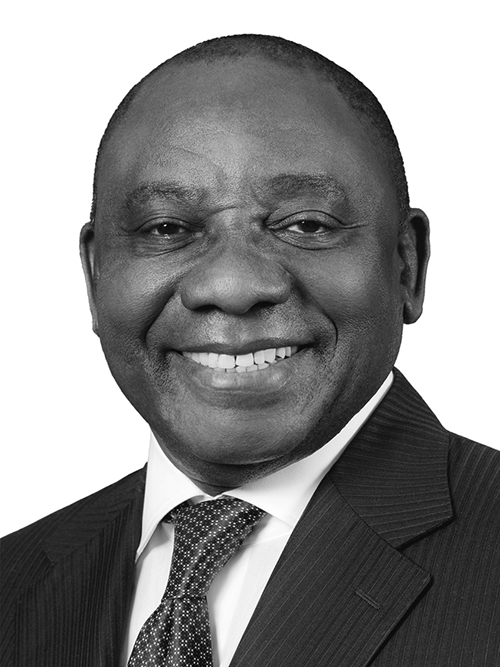
Keynote address by President Cyril Ramaphosa on the occasion of the 2026 National Heritage Day, Bongolethu Sports Stadium, Oudtshoorn
Programme Director,
Minister of Sport, Arts and Culture, Mr Gayton McKenzie,
Ministers and Deputy Ministers,
Members of Parliament,
Executive Mayor of the Greater Oudtshoorn Local Municipality, Cllr. Jan van der Ross,
Deputy Chair of the National House of Traditional and Khoisan Leaders, Nkosi Langa Mavuso,
All traditional, religious, faith and community leaders present,
Representatives of political parties, business and organised labour,
Our Living Human Treasures present here today,
Leiers en lede van die Oudtshoorn gemeenskap,
Distinguished guests,
Fellow South Africans,
Goeie dag. Molweni. Good Morning. Sanibonani. Dumelang. Ndi masiari. Avuxeni. Lotshani.
Groete aan die mense van die Klein Karoo! Dit is ń groot plesier om vandag hier by julle te wees.
Molweni bantu baseBongolethu, enkosi ngokusamkela apha namhlanje.
It is an honour to celebrate National Heritage Day in a place that bears witness to the lives of our earliest forebears.
Just outside Oudtshoorn you find some of the oldest and rarest ancient Khoi and San rock paintings, connecting us to a human story that was written thousands of years before our nation was born.
We pay tribute to our Khoi and San ancestors, and to all our forebears who birthed our many languages and traditions. This region connects us to a human story stretching back thousands of years.
We recognise our country’s Living Human Treasures, as well as the traditional practitioners, the storytellers and musicians, the healers, craftspeople, and knowledge holders.
We honour those who are preserving our natural heritage for the benefit of future generations, and we pledge to support this effort through the National Greening Campaign.
Oudtshoorn and Southern Cape bear testimony to a proud history of struggle in both the coloured and black communities of this region, under the banner of the United Democratic Front (UDF). We particularly honour the rich political legacies of the people of Bongolethu and Bridgton.
Their struggle and their sacrifices are a reminder that we were in the trenches of struggle together; as blacks, progressive whites, Indians and coloureds.
Aan die gemeenskap sê ons; julle bydrae is nie vergeet nie. Dit sal nie uitgewis word nie.
History records your contribution, and never shall it be erased.
Today, across our country, as South Africans we are celebrating who we are.
We are celebrating the languages we speak, the songs we sing, the food we prepare, the clothes we wear, the stories we tell and the customs we observe.
We are celebrating the traditions handed down to us by our parents and grandparents.
We are celebrating the knowledge of our elders and the imagination of our young people.
We are celebrating the extraordinary diversity of the South African people.
But Heritage Day is about more than celebrating where we come from.
That is why the theme of this year's Heritage Day is so important:
“Celebrating Our Living Heritage: Strengthening the Ties That Bind Us.”
Our heritage is living because it resides in people.
It lives in our homes and our communities.
It lives in the words of a grandmother telling a story to her grandchildren.
It lives in the knowledge of a traditional healer.
It lives in the hands of the craftsperson.
It lives in the songs of our musicians and the movements of our dancers.
It lives in our ceremonies, our faiths, our rituals and our ways of caring for one another.
It lives in the languages we speak every day.
And it lives in the simple but profound African understanding of ubuntu – that I am because you are.
This is our living heritage.
And today we honour the men and women who keep this heritage alive.
We honour our Living Human Treasures.
We honour the millions of ordinary South Africans who, often without recognition or reward, preserve our languages, traditions and indigenous knowledge.
They are the custodians of our collective memory.
We have a responsibility to ensure that their knowledge does not disappear when they are no longer with us.
We must record it.
We must teach it.
We must practise it.
And above all, we must pass it on.
Because a heritage that is not passed from one generation to another eventually ceases to be a living heritage.
Heritage is also about memory.
A nation that forgets its history risks losing its way.
We must remember the pain of our past.
We must remember dispossession.
We must remember slavery and colonialism.
We must remember apartheid.
We must remember forced removals.
We must remember the humiliation of people who were told that they could not live where they chose, work where they chose, love whom they chose or even enter through the same door as another South African - because of the colour of their skin.
But we must also remember resistance.
We must remember courage.
We must remember solidarity.
We must remember the millions of ordinary people who refused to accept that injustice was permanent.
And we must remember one of the greatest achievements of our people:
That after generations of conflict and division, South Africans chose to build one country, together.
That too is our heritage.
Our Constitution is our heritage. It is the tie that binds us together.
We are a country of many cultures.
We speak many languages.
We worship in different ways.
We have different histories.
We come from different communities.
We do not all look the same.
We do not always agree.
Yet we are all South Africans.
Our diversity does not make us less of a nation; our diversity is what makes us the nation that we are.
South Africa asks something different of us.
It asks that we bring all these identities together and build from them something greater.
It asks that we see in our diversity not a reason to separate, but a reason to learn from one another.
But belonging cannot only be something written in the Constitution.
It must be something people experience in their daily lives.
And that is where the challenge of our generation lies.
For although we have inherited freedom, that freedom is still unequally lived.
This freedom is not equally lived by a child born into privilege and a child born into poverty.
This freedom is not equally lived by someone who lives in a community where the streets are safe, and someone who lives every day with the fear of crime.
It is unequally lived by a household that can provide its own electricity and water, and a household dependent on a municipality that is failing to provide basic services.
It is unequally lived by a young person with access to education, technology and opportunity, and another young person whose circumstances deny them those opportunities.
And it is profoundly unequally lived by a man who can walk the streets without fear, and a woman who must constantly consider whether she will be safe.
If we want to strengthen the ties that bind us, we must close these distances between the lives of our people.
The abuse, rape and killing of women is not our heritage.
There is no culture worthy of the name that diminishes the dignity of women.
The pain and suffering that the women of South Africa have been put through stands out as a national shame.
The women of South Africa have the right to walk the streets of their country at any hour without fear.
In a few days, I will address the nation on the steps government is taking to confront gender-based violence, and to update South Africans on the investigation into the killings of women in and around Ekurhuleni.
Today, however, let us make a simple declaration:
Violence against women will not be part of the inheritance we leave to the next generation.
When we celebrate our heritage on this day, we don’t only refer to outward expressions of cultural pride.
Democracy is also our heritage.
We live in a country that upholds the right of every citizen to enjoy their culture, practice their religion and to speak and be taught in their own languages.
We live in a country that has strived to correct the historical injustices of the past by returning land to those who were dispossessed of it, including here in Oudtshoorn.
We live in a country where the children of farmworkers have equal rights to education and opportunity as the children of farmers; where the rights of farmworkers to decent working conditions are enforced, and where their rights to tenure and against arbitrary removal are protected.
We live in a country that recognises the institutions of traditional leadership and supports them in their duties of preserving heritage and guiding communities.
It has been the democratic government that has given formal recognition to Khoi and San traditional leadership, and has strived to preserve their historically marginalised languages.
Leiers en lede van die gemeenskap, Ons herinner ons hierdie geskiedenis nie om onsself te prys nie,
We recall this history not to praise ourselves.
We do so to celebrate how far we have come in building a country that belongs to all who live in it, whether they are black, white, Indian or coloured.
Our Constitution gives expression to the values of non-racism, non-sexism, equality and the pursuit of human dignity.
Since 1994, we have expanded access to education, healthcare, social protection, housing, basic services and economic opportunities.
We have built a robust political culture where all citizens have a voice and can actively participate in the life of the nation.
We have implemented policies and programmes to include once excluded majority, and at the same time consciously promoted reconciliation and nation-building.
This was the choice the South African people made in 1994.
We chose to recognise the injustices and suffering of the past, and in spite of that painful past, to live together and to build a new nation.
We chose ubuntu and empathy over bitterness, cooperation over conflict, and the pursuit of human dignity as our foremost aspiration.
These ideals are as much our national heritage as the cultures we practice and the languages we speak.
It is in pursuit of these ideals that South Africans made a conscious decision in 1994.
We chose reconciliation.
We chose non-racialism.
We chose equality before the law.
As we celebrate Heritage Day we need to ask ourselves what does it mean to be South African today?
What are we building?
A country of opportunity.
A country of equality.
A country where talent matters more than connections.
A country where public office is a responsibility and not a route to personal enrichment.
A country where a young person can dream, work and succeed.
A country where women are safe.
A country where our natural environment is protected.
A country that values knowledge and innovation while remaining rooted in its history and culture.
Where different races live together not merely in tolerance, but in mutual respect.
A country confident enough to embrace the future without forgetting where it comes from.
This is the heritage we must build.
Our task is to build a South Africa in which every person can truly experience the best of what our country can give its citizens.
A country where there is work.
Where there is dignity.
Where there is safety for the people of our country.
Where the government serves its people.
Where businesses invest.
Where workers prosper.
Where children learn
A South Africa where everyone can say - I belong here.
Our ancestors left us many things.
They left us languages.
They left us songs.
They left us stories.
They left us knowledge.
They left us traditions.
They left us this beautiful land.
They also left us lessons born from hardship, struggle, and sacrifice.
It is these wonderful endowments: the knowledge, the capability and the dedication that our forebears left us that are enabling us to deal with the challenges of our times such as:
- Dealing with the load shedding we experienced recently. We now gone for 470 days without load shedding;
- Fostering the economic empowerment of our people so that they can play an equal role in the economy of their country.
- Making sure that we have women who were previously held back, to enter into key positions in the leadership of the country, in Parliament, in the Judiciary,
- The knowledge and taglines of our forebears are enabling us to tackle youth unemployment.
We will continue to guard against our national unity being undermined by sowers of division who want to turn us against each other.
We must recognise that when it comes to holding the social fabric together, that we have a shared responsibility.
This is our South Africa. It belongs to all of us.
The actions and decisions we take now will determine whether we build this country, up or further break it.
Under the umbrella of the National Dialogue process, we want to write the next chapter of the South African story and craft a new vision for our country.
We have attained our freedom, the next step in our collective journey is giving meaning to that freedom.
Throughout history, nations have always rallied together when confronted by a common enemy.
In the past, our common enemy was apartheid.
Our enemy today is unemployment, gender-based violence, corruption, and alcohol and drug abuse.
We must tackle these problems together, like our forebears did when they fought side by side until they defeated apartheid.
Our common cause today is bringing about the conditions in which every South African can truly live the freedom that was promised them in 1994.
Let us rally around our shared values - whether we are black, white, Indian or coloured; male or female.
The time has come to restore the values of unity, ubuntu and dignity to our Republic.
For it is these three, not race, culture, language or geography, that truly make us who we are.
A nation cannot grow stronger unless its roots are nourished every day by its people.
I end with the words of a former resident of Oudtshoorn, the poet CJ Langenhoven,.
“My land het nuwe stryd gevind,
Vyand wat almal vir eens saam bind,
Gesiglose soldate veg stryd in the strate,
Halfhartige pogings laat nie vyand wyk,
Moet ons nog verder wag en kyk?
Vat voor, vat vas,
Skud af hierdie las
Wat sy vra is nie veel
Al wat sy vra is doen jou deel.”
As we celebrate our heritage this day, let us indeed all play our part.
Let us put our differences aside and choose to work together as we have done so many times in the past.
Let us choose unity. Let us choose ubuntu. Let us choose the pursuit of human dignity.
Let us choose this, our country, the Republic of South Africa.
God seën Suid-Afrika en beskerm haar mense.
May God bless South Africa and continue to protect her people.
I thank you.
.png)

.png)